Metrici — Airport Security Applications
Metrici AI · Airport Security

Airport Security
Applications

AI and video analytics have vast applications in airport security — integrating OCR, LPR, Line Counter, Area Counter, people and vehicle detection, vehicle classification, and thermal analysis to automate critical processes, enhance security, and improve the passenger experience end to end.

Airport Intelligence · Live ACTIVE
Security
234
pax/hr
Gate B2
147
waiting
Cargo
Clear
all scanned
Parking
Full
divert active
📄
Passport OCR — flagged watchlist match
Gate A1 · agent notified · 10:14:02
ALERT
🧳
Luggage scan — prohibited item detected
X-ray AI · lane 3 · secondary screening · 10:13:48
SCREEN
🔢
B 44 MET — LPR read · airside service gate
Whitelist match · barrier opened · 10:13:31
LPR
🚨
Unattended bag — Terminal B concourse
Video analytics · object detection · 10:12:55
OBJECT
🚧
Restricted zone breach — runway perimeter
People detection · no uniform · patrol dispatched · 10:12:14
INTRUSION
🅿️
Parking P1 full — LED display updated
PPD engine · divert to P2 activated · 10:11:40
PPD
18,420
Passengers today
5
Active alerts
99
Incidents
33
AI Cameras
01

Passenger Identification and Control

Engine · OCR

OCR for Document Scanning and Verification

Automating document scanning eliminates manual processing bottlenecks at every checkpoint — delivering both speed and accuracy that no manual team can maintain at scale across thousands of daily passengers.

  • Use OCR to automatically scan and extract data from passports, boarding passes, visas, and other travel documents at every security checkpoint — reading machine-readable zones without physical handling.
  • Validate documents against travel and immigration databases in real time, instantly flagging individuals on watchlists, those with expired credentials, or suspected forged documents.
  • Eliminate manual data entry by airport personnel — check-in and boarding processing accelerates significantly while verification accuracy improves.

People Counting and Crowd Monitoring

  • Deploy AI-based people counting to monitor passenger flow in real time — managing queues, preventing overcrowding before it develops, and optimizing staffing at each zone.
  • Balance the load across security checkpoints by tracking the number of passengers processed through each lane, enabling dynamic reallocation of staff and equipment to match demand.
Metrici Area Counter →
📄

Passport & Boarding Pass OCR

All machine-readable zones scanned automatically. Expiry, biometric data and travel history cross-checked against databases within seconds of presentation.

🚨

Watchlist Cross-Reference

Every document checked against national and international watchlists in real time. A match triggers an instant alert to the assigned agent — no manual lookup required.

👥

Real-Time People Counting

AI counts passengers at every checkpoint continuously. Surge detection triggers additional lane openings and staffing adjustments before queues become unmanageable.

Faster Processing, No Compromise

Document validation in under one second per passenger. Airport throughput increases while security rigour is maintained — the AI handles the volume, agents handle the exceptions.

02

Passenger Flow and Queue Management

Engine · Line Counter

Line Counter for Real-Time Flow Monitoring

Virtual counting lines placed at any gate, checkpoint, or corridor give airport operations teams precise, real-time data on passenger movement — with no physical barriers or turnstiles needed.

  • Track the exact number of passengers crossing specific points in real time — security checkpoints, boarding gates, baggage claim corridors, and emergency exits.
  • Monitor flow through emergency exits during evacuations, providing incident commanders with live data on how many people have left each zone and where bottlenecks are forming.
  • Detect abnormal movement patterns — passengers moving in reverse through a one-way corridor, gathering in transit-only zones, or accessing restricted areas — and alert security immediately.
  • Generate time-stamped crossing logs with classified counts per direction — a full audit trail for post-incident analysis, capacity planning, and regulatory reporting.
Metrici Line Counter →
Engine · Area Counter

Area Counter for Capacity and Queue Control

Monitoring zone occupancy in real time lets airport operations enforce capacity limits, optimize resource deployment, and detect crowd incidents before they escalate — automatically, across every zone simultaneously.

  • Track the number of people in waiting lounges, boarding areas, and check-in zones against defined capacity limits — trigger alerts when thresholds are approached.
  • Optimize passenger distribution across crowded areas — direct people to less congested zones or open additional security gates automatically when density thresholds are crossed.
  • Analyze crowd behaviour in real time, identifying loitering, unusual gathering patterns, or movement that may indicate a security threat or developing incident.
  • Monitor queue lengths at every airport stage — security, customs, check-in, boarding — and deploy additional resources dynamically in response to actual measured demand.
Metrici Area Counter →
03

Luggage Scanning and Security Screening

🧳

AI and Object Recognition for Luggage Screening

Integrate Metrici AI with X-ray machines or CT scanners to automatically recognize prohibited items in luggage — weapons, explosives, hazardous materials — reducing human error and accelerating screening throughput.

  • Custom-trained DNN models differentiate between benign objects such as electronics and dangerous items, improving detection accuracy beyond standard scanner thresholds
  • AI processes scanner output in real time — flagged items are highlighted for agent review without requiring the agent to assess every image independently
  • Detection performance improves continuously as models are retrained on new threat profiles and updated smuggling methods
🔍

Automated Threat Detection

AI systems are trained to detect patterns in luggage scans that indicate tampering, hidden contraband, or unusual internal structures — flagging bags for targeted physical inspection rather than random checks.

  • Pattern recognition identifies concealment techniques — double-walled bags, hollowed items, or unusual material densities — that visual review routinely misses
  • Threat confidence scores are generated per bag — high-confidence flags go directly to agent review; lower-confidence flags queue for secondary assessment
  • Historical flagging data feeds back into model training, improving detection rates for each specific airport's threat profile over time
🚨

Real-Time Alerts and Escalation

When a suspicious item is detected during luggage scanning, the system automatically triggers an alert for security personnel — ensuring immediate response without manual review delays between detection and action.

  • Instant notification with the specific lane, bag reference, and detected threat type — the agent knows exactly where to look before they arrive
  • Specific bags flagged for additional CT or physical screening based on identified risk factors — no blanket secondary screening required
  • All alerts logged with scanner image, timestamp, detection classification and agent response — complete incident record for compliance and audit
04

Baggage Handling and Tracking

📋

Automated Tag Reading

OCR, QR codes, and barcode scanning read every baggage tag automatically at sorting and transfer points — no manual checks needed across the full handling chain.

✈️

Flight and Destination Verification

Each bag's tag is validated against the flight manifest in real time. Misrouted or unmatched bags are flagged before they reach the wrong aircraft or carousel.

📍

End-to-End Journey Tracking

AI-driven tracking monitors every bag from check-in to aircraft loading and from landing to carousel — providing live status updates to ground operations and passengers.

⚠️

Misplaced and Delayed Baggage

AI detects bags that have deviated from their expected route or are stationary longer than normal — alerts fire before the problem reaches the passenger at claim.

Engine · OCR · QR · AI Tracking

OCR for Baggage Tags and AI-Powered Baggage Tracking

Lost and misrouted baggage is one of the most operationally costly and passenger-impacting problems in aviation. Automating tag reading and implementing AI-driven tracking across the full baggage journey eliminates the root causes of most handling errors.

  • Use OCR, QR code reading, and barcode scanning to automatically read and decode baggage tags at every handling point — ensuring luggage is correctly sorted and routed to the correct flight and destination without manual intervention.
  • Eliminate reliance on manual tag checks — every bag is accounted for at each stage of the process, from check-in counter to aircraft hold and from arrival to baggage claim.
  • Implement AI-driven tracking to monitor baggage movement throughout the entire airport — automatically detecting misplaced or delayed items and alerting ground operations with location and time data.
  • Provide real-time baggage status to operations dashboards — know exactly how many bags are loaded, in transit, or unaccounted for at any point during a turnaround.
Metrici QR Code Reader →
05

Parking Management Using LPR and Vehicle Recognition

🔢

LPR for Vehicle Identification and Access Control

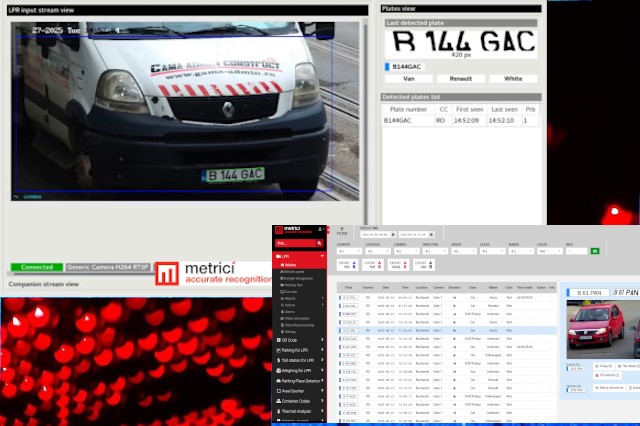
Implement Metrici LPR at airport parking entrances and exits to automatically recognize and register every vehicle — enabling seamless access control, payment automation, and restricted zone management without ticket machines or boom gate operators.

  • Staff, passenger, and VIP parking areas managed through plate-based action lists — only authorized vehicles access their assigned zones, enforced automatically at every entry point
  • Integrate with ATM payment machines and e-payment platforms — duration calculated from LPR entry/exit timestamps, payment triggered automatically on departure
  • Real-time available space count maintained from LPR vehicle counts — displayed on Metrici LED signs at each zone entrance
Metrici LPR →
🅿️

Parking Spot Management with PPD and Vehicle Recognition

Integrate Parking Place Detector with vehicle recognition to provide real-time spot availability — guiding arriving passengers directly to free spaces and eliminating the time and frustration of searching a multi-level car park.

  • Metrici AI cameras monitor every parking position continuously — detecting occupied and free spots without any ground sensors or installed hardware per space
  • Live availability data pushed to Metrici LED displays at zone entrances and on approach roads — passengers are guided before they enter the car park
  • Pre-booking integration using LPR to confirm reservations on entry — the reserved space is held and the vehicle is recognized and confirmed automatically upon arrival
Metrici PPD →
💳

Long-Term and Short-Term Parking Automation

Airport parking revenue is significant and operationally complex — different tariff zones, peak periods, dynamic pricing, and a mix of short-stay, long-stay, and staff parking all managed in one integrated LPR-driven system.

  • Long-term parking duration calculated automatically from LPR entry and exit reads — invoiced to registered accounts or triggered via integrated payment apps and ATM machines on exit
  • Short-term drop-off zones managed with automatic dwell time monitoring — overstaying vehicles flagged and fee applied or owner alerted without any physical attendant required
  • Dynamic pricing implemented based on real-time availability, time of day, and day of week — rate displayed on entry LED signs and applied automatically per plate at payment
LPR Parking Module →
06

Security Surveillance and Incident Detection

Engine · Video Analytics · Object Detection

AI Video Analytics for Continuous Surveillance

AI-powered video analytics continuously monitor every camera feed across the airport — detecting security threats the moment they appear rather than after a human operator happens to notice them on a monitor wall.

  • Monitor security cameras across all airport zones for suspicious behaviour, security breaches, and unauthorized presence — analysing every frame of every feed simultaneously without operator fatigue.
  • Detect and flag unattended baggage in terminals, concourses, and public areas — object detection identifies bags left stationary beyond a configurable time threshold and alerts the nearest security team.
  • AI analyses crowd behaviour patterns in real time — detecting panicked movement, mass gatherings in unusual locations, or sudden dispersal that may indicate a security threat or developing emergency.

People Detection and Intrusion Alerts

  • Deploy people and object detection in restricted areas — airfields, baggage handling zones, maintenance areas — to detect unauthorized individuals or those present without required uniforms.
  • Any individual detected in a restricted zone they should not access triggers an immediate alert with the camera feed and precise location, enabling rapid targeted response.
🎥

24/7 Automated Monitoring

Every camera watched simultaneously by AI — no operator fatigue, no missed frames, no blind spots across shift changes. Detection is consistent around the clock.

🧳

Unattended Object Detection

Bags and objects left stationary beyond a defined threshold are flagged automatically with location and elapsed time — agent alerted without requiring anyone to watch the feed.

🧠

Crowd Behaviour Analysis

AI learns normal flow patterns for each area of the terminal. Deviations — sudden surges, unusual gatherings, reverse movement — are flagged in real time before they escalate.

🚧

Uniform and Access Verification

People detection identifies individuals in restricted airside zones without the required uniform or equipment — alerts include camera snapshot and precise zone location for patrol dispatch.

07

Access Control for Restricted Areas

🚧

Intrusion Detection in Restricted Areas

Airports contain some of the most security-critical zones in any infrastructure environment — runways, baggage handling systems, fuel storage, maintenance bays, and radar facilities. AI-based intrusion detection provides continuous, automated monitoring of every one of these zones without requiring a dedicated human monitor at each location.

  • Deploy object and people detection in sensitive zones — runways, baggage handling areas, restricted employee-only facilities — to immediately detect unauthorized individuals or vehicles entering these spaces.
  • Integrate Line Counters at all restricted access points to track the exact count of people or vehicles entering and exiting. Any unauthorized entry triggers an instant alert with location, timestamp and camera capture.
  • Virtual perimeter lines around restricted areas activate alerts the moment they are crossed — no physical barrier needed, the AI boundary is the enforcement mechanism.
  • Distinguish between authorized personnel with correct uniforms and unauthorized individuals — alerts are specific to actual threats, reducing false alarm rates from legitimate staff movement.
Metrici Line Counter →
🚗

Vehicle Access Control with LPR

Airport airside areas and service gates handle a continuous flow of catering vehicles, fuel tankers, ground support equipment, and maintenance vehicles — all of which require controlled, audited access. LPR automates this process entirely, replacing manual badge checks and paper logs with a real-time, plate-level access record.

  • Deploy Metrici LPR at all airport service gates to control access to airside areas — only vehicles on the authorized plate list are granted entry, all others are held for verification.
  • Every vehicle movement through a service gate is logged with plate, vehicle type, direction, timestamp and camera capture — a complete, searchable access audit trail maintained automatically.
  • Integrate with scheduling systems — a catering truck arriving outside its approved window is denied access automatically, even if its plate is on the whitelist.
  • Alerts fire when a blacklisted or unrecognized vehicle approaches a service gate — security is notified before the vehicle reaches the barrier, not after a manual check reveals the problem.
Metrici LPR →
08

Operational Efficiency and Process Optimization

AI Queue Management · Analytics

AI for Dynamic Queue Management

Airport security throughput is a function of demand meeting capacity at the right moment. AI-driven queue management transforms static staff schedules into dynamic, real-time resource deployment — matching staffing to actual measured passenger flow at every checkpoint.

  • Use real-time video analytics to manage passenger queues at security, customs, and boarding — opening checkpoints and deploying staff in response to live measured demand rather than fixed schedules.
  • AI analyses historical queue data to predict peak periods with accuracy — enabling security and customs teams to prepare staffing and equipment in advance, before queues form rather than in reaction to them.
  • Automatically direct passengers to less congested checkpoints through connected display systems — distributing load across available capacity without requiring staff to manually manage flow.
  • Measure average processing time per passenger per lane — identify underperforming checkpoints and allocate supervisory or technical support based on actual measured data.
DNN Training · Predictive Maintenance

Custom AI for Predictive Maintenance

Airport operations depend on hundreds of mechanical and electronic systems running without interruption — baggage conveyor belts, X-ray machines, check-in kiosks, jet bridges, and elevators. AI-based predictive maintenance replaces reactive breakdown management with proactive, data-driven servicing.

  • Train AI models to monitor critical airport equipment — baggage conveyor belts, X-ray and CT scanner systems, and elevator infrastructure — detecting early signs of degradation or abnormal operation before failure occurs.
  • DNN models learn each system's normal operational signature — anomalies in vibration, temperature, throughput rate, or cycle time are flagged for maintenance review before they cause a breakdown.
  • Maintenance is scheduled based on actual measured equipment condition rather than fixed intervals — reducing both unnecessary servicing costs and the risk of unexpected failures during peak operating periods.
  • All anomaly events logged with equipment ID, timestamp, detected deviation and recommended action — maintenance teams receive prioritized work orders generated automatically from AI monitoring.

09

Custom AI and DNN Training for Airport-Specific Solutions

🎓

Airport-Specific Object Recognition

DNN models trained on objects unique to your airport — staff badge designs, ground equipment types, specific security gear — enabling automatic verification without generic detection limitations.

🎯

Threat Profile Training

Models trained on the specific contraband profiles, concealment methods and threat objects relevant to your airport's routes and passenger demographics — accuracy far exceeds generic models.

🔁

Continuous Model Improvement

Every confirmed detection and corrected false positive feeds back into model refinement. The system becomes measurably more accurate with operational time at each specific installation.

🛠️

Credential and Equipment Verification

AI trained to recognise staff badges, security equipment and authorised vehicle types — automating verification processes that currently require human review at every checkpoint.

DNN Training · Custom Deployment

Training AI to Know Your Airport

No two airports present identical security challenges. Metrici's deep neural network can be trained on the specific objects, behaviours, personnel types, and threat profiles that matter at your specific facility — delivering detection performance that no generic model can match.

  • Develop custom AI models trained on airport-specific objects — staff badges, security equipment, ground vehicle types, catering trolleys — to automate credential verification and equipment tracking without manual checks.
  • Train models to recognize misplaced or unauthorized equipment in sensitive areas — tools left in engine access zones, luggage in cargo-only areas, or unrecognized equipment near aircraft.
  • Adapt object recognition models to your airport's specific infrastructure — camera angles, lighting conditions, terminal architecture and seasonal variations are all factored into training.
  • Models updated as threat profiles and security requirements evolve — new personnel types, new equipment classes, or updated badge designs incorporated through targeted retraining without hardware changes.
  • Custom behaviour models built from your airport's own incident history — the AI learns what counts as suspicious at this specific facility based on real data, not generic rules.
10

Border Control and Immigration at Airport Gates

Step 01
📄

Document OCR

Passport and visa scanned. MRZ data extracted and cross-referenced against immigration databases in real time.

Step 02
🔢

LPR Verification

Vehicle plate matched against international databases of flagged and cleared registrations. Access granted or held automatically.

Step 03
👥

People Detection

Passenger count and flow monitored at every crossing point. Unauthorized entries and loitering flagged in real time.

Step 04
⚖️

Alert or Clearance

Cleared passengers proceed. Flagged individuals trigger agent alert with document image, match type and gate location.

Engine · OCR · LPR

OCR and LPR for Document and Vehicle Verification

At international airport gates, border control requires the same multi-layered AI approach as land crossings — document verification, vehicle monitoring, and people detection working together in a unified automated workflow.

  • Use OCR to automate the scanning and validation of passports, visas, and identification documents at airport border checkpoints — verifying traveller information against immigration databases and flagging watchlist matches without manual lookup.
  • Deploy LPR at airport service and vehicle entry points to monitor vehicles crossing into restricted airside areas, matching plates against international databases of flagged or stolen vehicles in real time.
  • Automatically control access to secure zones based on LPR results — only plate-verified authorized vehicles pass through; all others are directed to inspection lanes without manual intervention.
Border Control Applications →
Engine · People Detection · Area Counter

People Detection and Counting at Entry Points

Managing the flow of international passengers through immigration requires real-time visibility of every entry point — not periodic headcounts or manual observation, but continuous AI monitoring that keeps pace with thousands of crossings per hour.

  • Use AI-based people detection and counting systems at airport border entry points to monitor the number of passengers crossing, ensuring orderly processing and detecting sudden flow changes that require additional staffing.
  • Detect and flag unauthorized entries at immigration gates — individuals attempting to bypass document control, access staff-only lanes, or loiter near border zones are identified and flagged for immediate agent intervention.
  • Combine people detection with Area Counter engines to monitor waiting area density at immigration queues — triggering additional lane openings and staffing adjustments before queue lengths become unmanageable.
Metrici Area Counter →
Conclusion

A Complete AI Security Stack for the Modern Airport

By combining AI video analytics, OCR, LPR, QR and barcode reading, Line and Area Counter, people and object detection, and custom DNN training, airports can build a fully integrated, multi-layered security and operations intelligence system that addresses every dimension of modern airport management — from passenger identification and luggage screening to perimeter security, parking automation, and equipment predictive maintenance.

These technologies transform security from a reactive, resource-intensive operation into a proactive, data-driven one. The AI watches every feed, reads every document, counts every passenger, and flags every anomaly — around the clock, without fatigue, and faster than any human team can respond. The result is an airport that is measurably safer, operationally more efficient, and better equipped to handle both routine demand and high-risk security scenarios.

Engines Used in This Application

Built on the Full Metrici Suite

Every capability on this page is powered by a dedicated Metrici product — each available standalone or combined in a unified airport deployment.

Get Started

Smarter Airports Start Here.

From a single terminal to a full international hub — Metrici deploys on your existing cameras and delivers real-time airport security intelligence, operational automation and compliance reporting from day one.